Sunday, October 24, 2010

What Half Pad Would H


the only advantage of DVD is that it lends itself easily. what a pity it is also prohibited.
ah so it no longer has any interest. no really.

Saturday, October 23, 2010

Will The Tahoe Change Body Styles

The Sword and the vital breath


The sword has always been an object of fascination, regardless of culture or historical period to which it attaches. From a practical object, first for the war, she might have changed during different periods of history into a symbolic object, sacred due in part to the incredible complexity that constitutes its manufacture.

Forge is a magical character and are secrets of making a blade would sometimes bind to the blood well before use: Some myths claim that the blades hot iron plunged into animals were sacrificed to cool. A ritual which thus arise the blade in the blood.
This myth, if it existed, could be explained by a chemical process: In the soaking in blood, the blade would undertake in carbon steel and would ...


Reproduction of a sword from the Tang Dynasty by the Hanwei forge


Without losing ourselves in superstitions, it can be argued that guilds of blacksmiths have spawned several cults and spiritual power. The analogy between the manufacture of blades and the symbol of creation is obvious: The primary control of many elements (fire, water, earth, wood, metal, air) required for this manufacturing process had any meaning at times when the symbolism was basis of religious practice.
Thus, in the various alchemical currents of the East and Far East, manufacturing and metal processing are compared with a specific spiritual path.


Reportage (part one) in English on the manufacture of swords in China


The practice of the sword, when with it was the first in the history of China to be expressed in writing with a vocabulary of spiritual practices:

According to Prof. Meir Shahar, PhD Chinese Languages and Civilization Harvard University, is the use of the symbolism of the sword, scouring among Taoists that could be the original incorporation of techniques of vital breath (Daoyin) fencing in the first century AD. This is evidenced by a text dating from the second century AD and entitled "The annals of the spring-autumn period of Wu and Yue kingdoms (Yue Wu Chunqiu) in which an accomplished swordsman is invited by the king of Yue coming to teach fencing. The explanations of the swordplay are then given by the fencer using the vocabulary of Daoyin:

"The art of the sword is extremely subtle and elusive. Its principles are particularly deep secrets. The Dao has its doors for entry and exit, the yin and yang. Open the front doors and close the doors and out, yin and yang declines rises. When we practice the art of fighting face to face, he must concentrate his mind on the inside and give the impression relaxation outdoors. You must look like a modest woman and hit like a fierce tiger. When you take different postures, regulate your Qi moving consistently with the spirit (Shen). Your technical superiority should be as obvious as the sun and as striking a fleeing hare. Your opponent must put all his enthusiasm to continue your form and make your hombre chase, implying that your image must be between dreams and reality. Your breathing should go freely from the inside out without ever being adopted. Whether you are in melee with your opponent forces horizontal or vertical, in the direction of or against the movement, never attacks head on. Mastery of this art must allow a person to confront one hundred and one hundred people to face a thousand. If your Majesty wishes to have an overview, I can do a demonstration for his leadership. "


Nowadays, if the Chinese sword no longer fabulous character and mystique that was once attributed to him - The Taoist priests lent their magical power blades, considering them as incarnations of the Dragons - They are found in some symbolic evocation rituals. "The Magic Sword" is a "mudra (hand-shaped symbol) still used in some Taoist rites and whose function is to" cut "or" point ".


The Pran mudra, sword Magical Taoism


In Indian culture, which is found in Hinduism and Buddhism This mudra is called "Pran" and it serves to equalize the left and right hemispheres of the brain, contributing to an overall balance of the person and good mental health ...

Sunday, October 17, 2010

Program For A Church Banquet

St Petersburg - Peter, Paul and the Romanovs

second day in St Petersburg. The guide is very nice: the evidence, it gives us an appointment at 10am (8am Paris time anyway). After a breakfast enjoyed by Francis, who is able to slip a hard boiled egg in the morning (which is not my case - my stomach waking up even harder than me), we embark on the bus. let's go for a walk in the city.

first stop on the edge of Vasilevsky Island, along the Neva. the place is decorated with two rostral columns.
Will you find the theme of the column?
From this square we can admire the many buildings. The Hermitage, the former Stock Exchange, several churches whose names I forget. what a surprise, it is obviously the size of buildings. everything is great, the river, monuments, and everything is very colorful. ocher, yellow, blue, everything is mixed and it sounds very sympathetic to the city. nothing to do with our big gray stones and our slate roofs. the weather is beautiful, we are already surrounded by sellers of travel guides, hats and more.

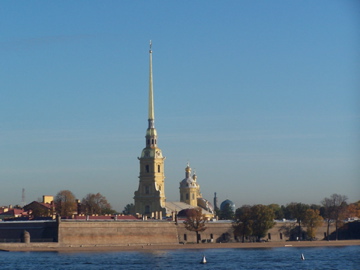
Before us stands the Peter and Paul Fortress, with its cathedral. if I remember correctly this is the first building constructed, but I'm too lazy to check: p

top of the spire, an angel. Legend says that it is done in real size.
The cathedral houses the tombs of the Romanovs, Peter the Great to Nicolas II whose remains were recovered and transferred recently.

You also review your Russian and genealogy of the Romanovs


before leaving, guides us into a small room occupied by five Orthodox priests . the doors close behind us, and the conductor tells us they're going to change a traditional Russian Orthodox chant. is probably one of the moments most impressive of the trip: the song is beautiful, and one of the singer with a bass voice really ... serious:)

is then the turn of the fortress. a cannon is fired from there every day at noon, and we are not immune. it wakes everybody up at once. we admire some locals caught sunbathing in bikini while it was 12 degrees. I must say that the sun is rare in the corner, so when there are spaces benefit.

first lunch in a restaurant. there is some vodka "Russian Standard" as an aperitif. she is super good. for Paris, I note that it is sold in stores Russian Motte Picquet and Dupleix. good, prices are not the same but it's worth it.

then we pass the afternoon to walk. we pass the KGB building, the guide tells us what was going on ... I'm not going to rewrite everything, but you just know that 1000 people were executed by night in the worst times of Stalinism. Russians say that the cellars of the building have a beautiful view of Siberia.

its pranks, short stop in a store for tourists.
we finished the day with a performance of traditional Russian song and dance, followed by a tour of StPetersbourg by night.
During the show, Francis had a crush on this bass. wait for the next concert clones!